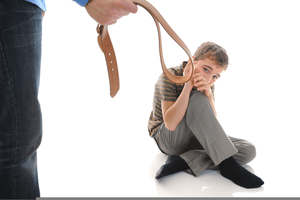
Discipline. It’s one of the most widely debated parenting topics. On one extreme you have those who don’t believe much in any discipline at all and will simply talk to their children about how they are being disobedient without laying down any consequences, on the other extreme you have those who believe that children should be seen and not heard and that they must obey everything an adult says without question or they will get spanked. Most of us fall somewhere in the middle of these two extremes, but it is still difficult to develop effective discipline. In Steinburg (2005) it lays out some ground rules that may be helpful to parents struggling with effective discipline. Her principles focus on the correct way to maintain obedience without using harsh punishments
Never Use physical punishment
A spanking is one of the simplest and easiest forms of punishment, which is why many parents default to it. The problem with spanking is that it does not effectively change behavior, and in many children, it can have grave side effects. What spanking generally teaches a child isn’t obedience, it is to avoid punishment. The child usually stops the specific behavior that caused him to be spanked for now, but he is no more likely to obey in the future, and he may learn to just do it where no one can see. Spanking has also been shown to increase aggression in children, causing problems at school and with peers. Of course, not every child who is spanked becomes aggressive, but why risk it when this form of punishment isn’t very effective to begin with?
Don’t be Verbally Abusive
Screaming, yelling, belittling, name-calling, none of these should be tools parents use to correct their children. As adults and as parents we automatically are in a position of power over children, and they are keenly aware of that. The way we talk to them shows whether or not we deem them as beings that deserve our respect. If our children can sense that we don’t respect them, or have their best interests at heart, they are not going to be interested in what we have to say. Instead they will be internalizing the message that they are not good enough or worthy of love. Emotional abuse can have worse effects on a child than physical abuse.
Control Your Anger
Everyone will, at one point or another, become very angry with their child. That is a human emotion that we can all relate to, and there is nothing inherently wrong with feeling angry. The problem comes when we try to punish or correct a child out of a place of anger. This can lead to using the ineffective tactics like physical punishment and verbal abuse that we’ve discussed above. It can also lead us to declaring punishments that are overboard, or that we don’t want to enforce. A parent in a fit of anger may say things like “you’re not allowed to play baseball anymore!” or “You’re never allowed to drive the car again!”. The parent likely does not truly want to carry out these punishments and will have to go back on their word, undermining themselves. It is much better to give yourself a moment to regain control before deciding on a punishment.
Punishing the Right Way
We have just gone over some of the “don’ts” of punish, now let’s go over correct discipline techniques. First, let your child know exactly what they’ve done wrong. Sometimes young children are not truly aware of what they have done that was wrong, or a child may think they are getting punished for something other than what you are actually trying to correct them on. Second, briefly go over the why you cannot allow the behavior. Children respond better when they know the why behind the rules. Third, suggest what the child could do next time. This helps them develop the critical thinking skills to make better decisions next time. Fourth, state what the consequence for their behavior is. This should be done in a calm and concise matter and not turn into a lecture. Fifth, give your child the assurance that you love them and that you know they are going to improve in the future.
When we take care to avoid damaging techniques and we develop consistency in our discipline, we will give our children the tools they need for success. They will understand why obedience can be a benefit to them and feel our love for them. Here is a great video that outlines what we have talked about from the CDC: https://www.youtube.com/watch?v=bsCMWwyaWTk
Sources:
Steinberg, L. D. (2005). The ten basic principles of good parenting. New York: Simon & Schuster Paperbacks.
 Craysy Life